 |
||
| Ten Dancing
Cubicles 2026 - Prague For volume control use Google Chrome
|
by Dan Senn For Stereo or Quad Speakers (Use earbuds, headphones or large system.) Total duration = 36'01" |
|
Ten Dancing Cubicles
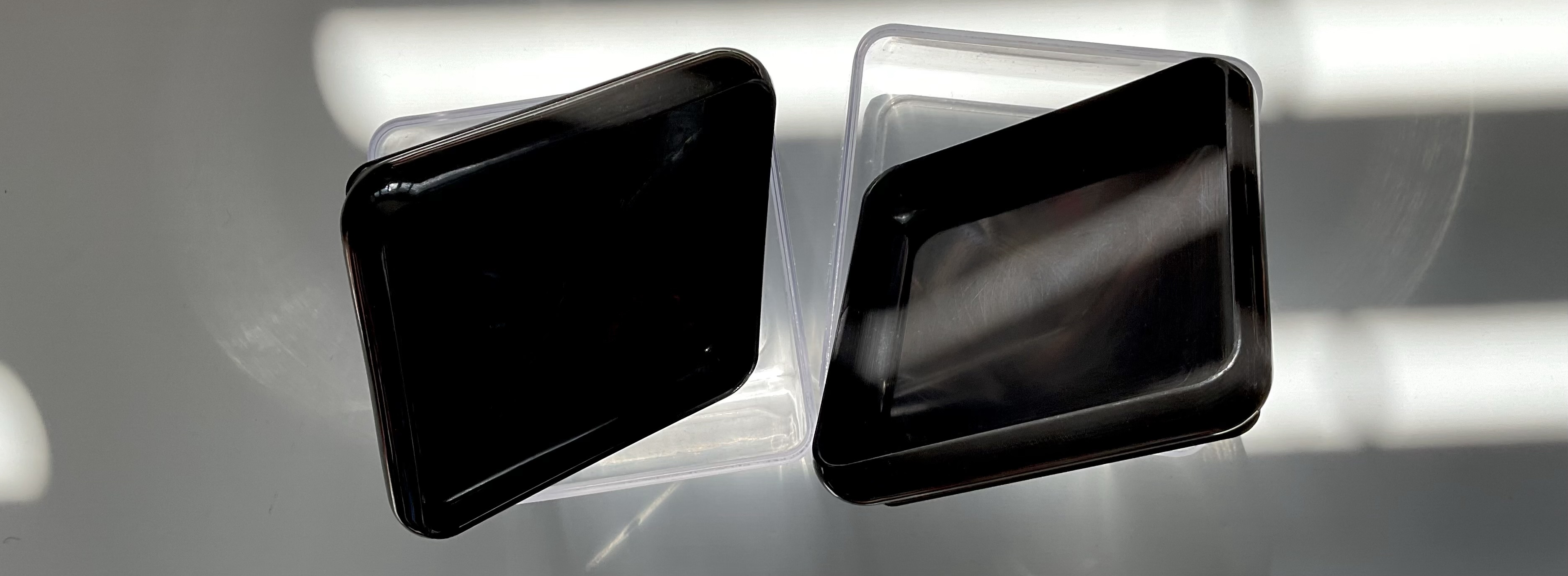
by Dan Senn was composed in May, 2026 using identical plastic, kitchen
storage containers with black lids that were performed and edited at
Gasworks
Studio in Holešovice, Prague, Czechia. They were recorded using 32
bit
float technology with the mp3 files in the center column here
representative but inferior to the 32bit .wav
originals. If you wish to present the these publicly, contact the
composer at rakutoo (at) me dot com.
When listening to these works using an iOS-like device use earbuds or headphones. With such devices, some of the 32bit fidelity will still be lost. Even so, the spatial and gestural-temporal aspects of these "sound dances” will be present. The spatial positioning of events in TDC is controlled stochastically. Slight-to-drastic timbral and pitch shifts were manually effected at the meta-improv editing state (read more below), treated performatively and integrally part of the initial improvisation enacted by the composer-performer-editor (me). It is not sensible for another party to make these post-live creative decisions. As the live improvisation is, of course, “real-time”, the edited “improvisations” are thus a “meta-performance” made in a form of altered state. As the live performance is optimal, the meta performance functions to "detail" and shape the sound of objects meant to hold coffee beans or peanuts (blanched). Even if the un-enhanced initial effort is of standalone quality, the meta-performed (edited) version by the artist, is important. In one instance, for example, a meta-edited version of the live work was mixed with the unedited original to create the final work. To overlook these performative stages just above is normal except that in variance, this considerateness is conceptually intriguing. As assigning each step to a different artist is normal, an industry standard, but in the context of TDC, it brings ego-contentiousness to the fore. Here, in these works, I am working with two sides of the same brain, each with unique skill sets. This is quite natural for me as I am an experienced improviser and editor. I am a classically trained composer, a sound and visual artist in various fields. Therefore, the last thing I want is a detached specialist messing with my found-object improvisation. Spontaneity, a primary focus, the opposite of mirroring in art, points at one artist. Not two or a group or a country or style, etc. Indeed, when I listen to the final meta-performed (edited) product of these works, the power of this sharpening stage is quickly lost to the memory and dominance of the unadorned original. One is “nekked”, the other “painted” and, perhaps, trimmed, a natural extension indelibly linked to the action-memory of the original, this already twisted by Scrapercussion and Raku pottery. Thus, the cognitive integrations between this and that side of the brain, this and that medium, the live found-object improvisation and imminent meta-performance (edit state) are mutually preemptive. I have written about spontaneity and its absence in mirrored artifacts and that mirroring plays a dynamic role in improvisation, mostly negative. About the usefulness of using purposefully awkward instruments, common found objects, to consciously overcome cliche development in experimental music. About how found instruments are by nature opaque, act as musical scores and that improvisations so derived graduate to the meta-editing stage (realized by the same artist) often produce unique and spontaneous artifacts. This is, therefore, germane in the context of this TDC collection. * Mirroring is always present to some extent in art as it reflects human memory. The mere act of actively restricting it using systems, and/or restraint, can effect an interesting "drama" as demonstrated in Drying Rack and Lid from Flat Works (2024). |
Attenuate tracks individually. Eleven Moveable Sections* Play multiple works simultaneously?! 1-Trumpet Lessons (see * version) 2-PuhPuhPuhPlastique 3-What It Is (see * version) 4-Waltz, Between Strikes 5-Peace|Piece|Pianissimo|Prosím 6-Knock About 7-Nineteen Fifty Five Oh Five 8-Towards Trenčín 9-Amidst The Chatter 10-Close Scrapes What It Is | Amidst The Chatter ** ** A mix of 2 works that may be performed in quad. Improvising on found instruments, I avoid traditional mallets or mallet-like objects alien to the object itself as these easily trivialise, via performance practice, the object and performance. I use my hands, loose parts of the same object or the hard surface the objects rested upon. I used the black covers to strike each other or the plastic cubicles. I used the table they rested on as a strike or scraping surface. My dry, bare hands were used to rub, tap, and snap the cubicles and lids... I did not rehearse but for a few seconds before recording and then only to get an idea of the performance direction for this track. With 32 bit float technology, I didn’t need to set levels. The excellent mono mic, an At4045, was always within inches of the found object. For simplicity and speed I used a Zoom H4Ne with this external mic all powered by a power bank. I wore headphones. After a session the recorded data was transported briskly to my MacBook Pro and Ableton Live on mini-chip. Recordings were made in an isolated, dead room. Moving left to right in the image below (click to enlarge), the sound processing routines used in Ableton Live were a simple gate (Softly), a stereo locator (Slow & Steady), an equaliser (EQ8), a phaser (Phasing) and a limiter (Upper Limit). The volume was controlled via the default mixer. Most traditional editing rules were tossed due to the 32bit float tech. For example, every improv was edited at an absurd +12db base gain with no attention given to high peaking levels. The entire signal was master limited to 0db, this naturally compressing the entire signal without clipping concerns.  Related works: Trumpet Lessons* '26, What It Is* '26, Four Floaters '26, Jello Mold '26, Uličnická Galerie '25, Flat Works '24, Tin Pan Salvo '22 |
Performance
Ordering: TDC
may be performed sequentially, as presented in the middle column, or
reordered at random with a brief silence between sections. It is Ok
to perform only one, or two, or three of the sections. They
may be interspersed between other compositions on a concert. Any
combination of these may be used for dance accompaniment or
background to nice, mostly silent, meal. Contact
the composer at rakutoo
(at) icloud dot com for
the 32-bit float .wav versions.
Dan
Senn (Prague-Watertown) is an
intermedia artist working in music composition and production, kinetic
sound sculpture, installation work, experimental and documentary film.
He has been a
professor of music and art in the United States and Australia and
travels internationally as a lecturer, performer, producer and
installation
artist. He lives in Prague where he directs the Echofluxx Media Art
festivals,
and Watertown, Wisconsin, the USA, with his partner-collaborator,
Caroline. Dan's work moves freely between expressive extremes,
languages and mediums depending on the aesthetic joust at hand. He is
cofounder
of Roulette Intermedium in New York
Cty (Brooklyn), Cascadia Composers of
Portland Oregon, and the Echofluxx
media
festivals in Prague. (read more)
The most used modules were the gate (threshold, attack and release settings) adjusted often event by event, and then the phaser treated likewise. Other processors were uniquely set for each improvisation, an arbitrary default setting that remained throughout a session except for in a few instances. My practice was to set global parameters/characteristics for an entire improv track and then to move incrementally through the entire work focusing on one module, one parameter, or on minute aspect of the same. I would fine tune the smallest event characteristics using, say, the “release” wheel on the gate processor throughout and then returned to the beginning to adjust another parameter. This describes a tendency, as I did not fixate on rules. While micro-editing a work at the meta-performance stage I worked rapidly and “up close” allowing my intuition to dictate shifts. I’d occasionally listen to completed sections but this was mostly to reinstate continuity after a work break. I mention this because, after editing the entire work myopically, I was repeatedly surprised how this detailing disappeared sensibly into the original improvisation while providing a renewed overall presence. This happens analogously when editing photos and some video. Studying ceramics in my early 20s with Leonard Stach, I once complained to him that my ideas were being copied by other students and that it got under my skin. In a large common university ceramic studio, student's and professor's work is made, dried, glazed and fired in the same open space. Len’s response to my self-important question was “Don’t worry Dan. They’ll just f*** it up anyways.” He was right and I was satisfied. Over time, I expanded this advise to include descriptions of my work methods in every area as I endeavored to form an attitude of openness. Working side-by-side with Len Stach at the UW-LaCrosse influenced me profoundly. Working this way with composers like Salvatore Martirano at the U of I, even if he had his own home studio where he was building the fabulously innovative Sal-Mar Construction, impacted me likewise. My relationship with these artists was exquisitely collegial. I toured with Sal, his talented partner Dorothy performed my music. I was a frequent guest at their home in Urbana. Dorothy’s generous father, Truman Dan Hayes, had been my first music composition teacher. None of these gifted men had professional secrets. DS060626 |